The Secret to Rebranding with Impact: Why Vision Matters More Than Budget
Rebranding is often seen as a design exercise, but the organisations that create real impact know it starts much earlier. The difference between a rebrand that lands and one that falls flat rarely comes down to budget. It comes from clarity of vision, disciplined choices and a deep understanding of what the brand needs to become. When those foundations are in place, the creative work has something meaningful to stand on.
Rebranding as Proof of Leadership Vision
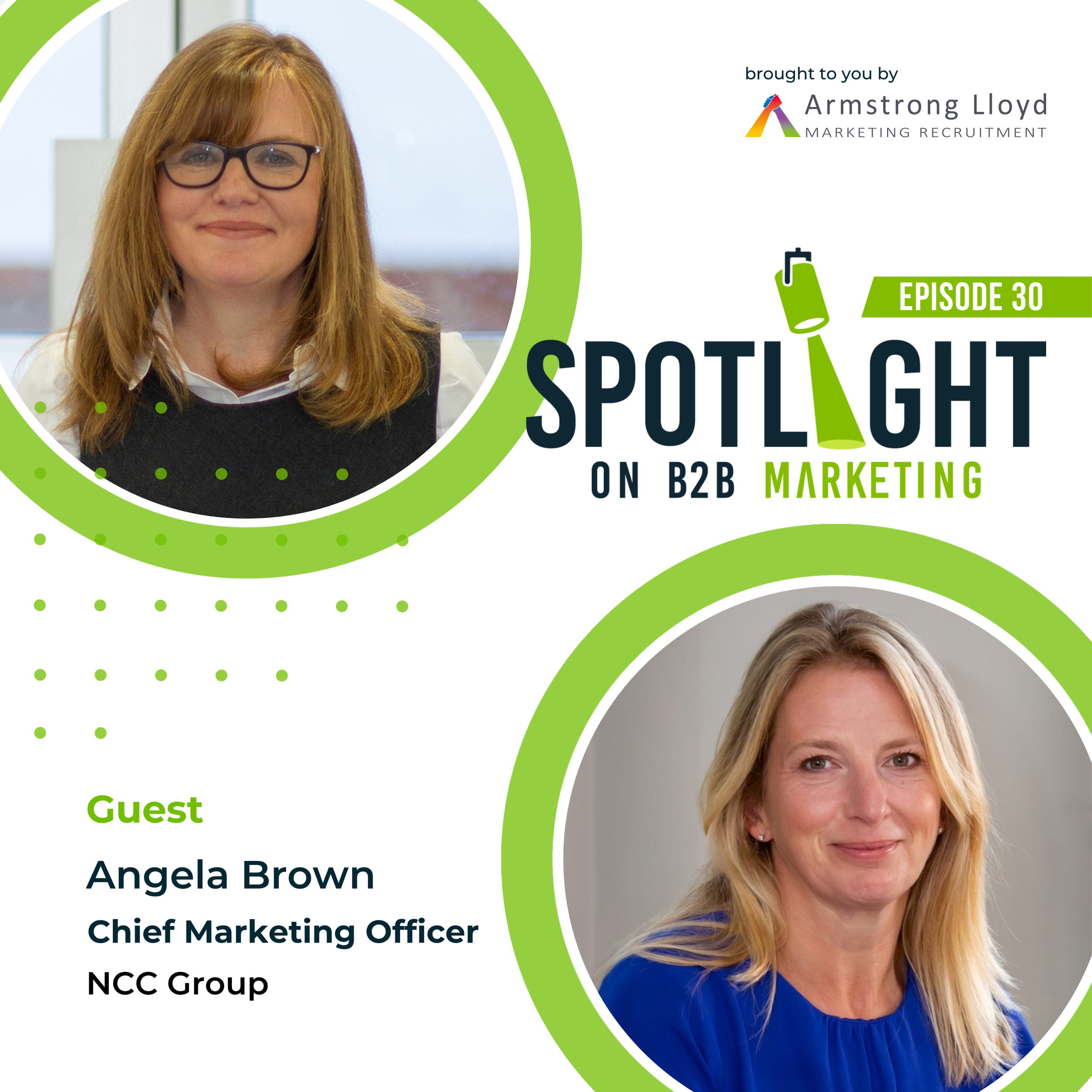
When you're appointed to lead a marketing function in January, and by April the business has issued a profit warning, you might reasonably wonder if you've made a terrible mistake. Yet that's precisely when Angela Brown, Chief Marketing Officer at NCC Group, began executing a complete brand transformation. This isn't a story about having the budget to do everything you want – it's a story about how clear vision and disciplined decision-making can achieve what seemingly unlimited resources cannot.
Angela recently appeared on an episode of the Spotlight on B2B Marketing podcast to discuss how she led her global marketing team through this transformation. Her insights reveal something fundamental: the most effective rebrands aren't about the logo design – they're about the foundational thinking that makes everything else coherent.
Karen Lloyd, host of the Spotlight on B2B Marketing podcast, reinforces this point. Branding is one of the most emotional areas of marketing, which is precisely why a strong framework matters. Without it, rebrands risk becoming exercises in personal preference rather than the strategic transformation Angela delivered.
Understanding the Framework Beyond the Logo
When Angela first presented the new NCC Group logo to the executive team, the reaction was muted. It was a reminder that leaders often struggle to understand brand change when a logo is shown on its own.
What changed the room was context. Once Angela showed how the brand would look on LinkedIn, marketing materials, exhibitions and other real applications, the team finally saw its impact. As she explains, you cannot assume people will connect the vision to the creative and then to how it works in real life. You have to guide them through it.
For marketing leaders, this distinction is important. The visible parts of a rebrand sit on top of deeper strategic work. This includes understanding the organisation’s heritage, the principles behind its success and the reason the rebrand is needed.
The NCC Group rebrand followed this approach. With roots in the 1960s as the National Computing Center, the new identity used three woven threads to represent insight, innovation and intelligence. It honoured the organisation’s history while signalling confidence in its future as a global cybersecurity leader.
Making Critical Decisions Quickly and Confidently
One of Angela's most striking leadership principles addresses how organisations delay progress through endless consultation. “Nothing goes anywhere without a sponsor,” she explains, and she made a deliberate decision that the rebrand would not be determined by committee. Instead, she and the Managing Director of the business unit became the decision makers, taking stakeholders on the journey but not being directed by every piece of feedback.
This doesn't mean ignoring stakeholder voices. Angela conducted extensive interviews with internal and external stakeholders, listening carefully to their perspectives. But she also recognised that attempting to honour every opinion would paralysise progress. The organisation had attempted to build the new brand name and identity through something akin to “Boaty McBoatface” democratic voting, which she consciously rejected.
This approach to decision-making extends beyond branding into all aspects of marketing leadership. When budgets tightened and Angela needed to eliminate ineffective activities, she trusted her judgment alongside data. “Be data informed as a leader in marketing and draw on your experience,” Angela advises. “When your gut's telling you this is not good, rely on that. Don't waste lots of time trying to validate what you know is a good or a bad decision. Just move forward with it.”
Restructuring for Global Performance

The rebrand was only one part of Angela’s wider transformation agenda. At the same time, the business was shifting from regional silos to a global operating model, which meant completely restructuring the marketing function. Regional teams had to be replaced with a structure that could support a unified global organisation.
This revealed a common issue in marketing teams. They were top‑heavy, with too many senior people tied up in execution and not enough junior talent to support delivery. Angela hired junior marketing communications executives to free senior leaders for strategic work while building a future talent pipeline.
She also uncovered long‑standing inefficiencies. The organisation had twenty‑four separate websites despite having only a few thousand employees. Internal communications was over‑resourced compared to external, market‑facing work. The team lacked in‑house brand capability and relied heavily on agencies, which slowed delivery and created inconsistency.
Angela’s solution included building an in‑house design team in Manila, consolidating the websites to a small number, and rebalancing internal and external communications. Her advice is simple: change takes time. Quick wins matter because they create the breathing room needed for the harder work that follows.
Competing When Rivals Have Deeper Pockets
One of Angela’s toughest challenges was competing in cybersecurity against private‑equity backed rivals with huge digital advertising budgets. NCC Group had become overly reliant on expensive search advertising in markets like North America, where costs were rising and returns were falling.
Angela challenged the assumption that this was the only way to grow. Cybersecurity is a trust‑driven services business, and she believed relationships could not be built from behind a laptop. Clients make decisions through people, not ads, so the team needed to be present in the market.
This required a cultural shift. The organisation had not historically invested in events or experiential marketing, and Angela met resistance. She led from the front, becoming a “player manager” and getting hands‑on with event strategy to show the value of the new approach.
What she proved is a principle that applies far beyond cybersecurity. In complex B2B environments, marketing effectiveness is not dictated by budget size. It comes from strategic clarity and disciplined execution. By moving spend away from costly digital channels and toward relationship‑building activities, and by focusing only on what genuinely drove impact, the team achieved results far beyond their scale.
What Can Business and Marketing Leaders Implement for Their Teams?
For senior leaders managing marketing teams, particularly those facing budget pressures or planning significant changes, Angela's experience offers concrete frameworks for implementation.
Build decision-making clarity before stakeholder engagement. Be explicit about who decides what, who holds veto rights and how decisions will be made. This reduces friction, speeds progress and prevents the paralysis that often slows restructures and rebrands.
Invest time in foundational thinking before creative execution. Define the strategy, the heritage you are protecting and the position you want to claim before any creative or structural work begins. This ensures coherence and helps you hire the right people before attempting major change.
Rebalance your team structure for the work you actually need to deliver. Most marketing functions are top‑heavy or overly reliant on external agencies. Rebalancing capability improves agility, frees senior talent for strategic work and builds a pipeline of future leaders.
Question your channel strategy ruthlessly, particularly when facing budget pressure. The most expensive channels are not always the most effective, especially in relationship‑driven B2B environments. Use data to understand what truly drives value and be willing to stop activities that no longer serve the strategy.
These are the leaders who build marketing functions that can deliver sustained performance, creating momentum that continues long after the immediate transformation is complete.
About Karen Lloyd

As the founder and director behind our recruitment approach, I bring almost 30 years of unique expertise spanning both recruitment and marketing. Having placed my first candidate in 1996, I've since built 5 start-ups, served as a Board Director for 25 years and developed recruitment strategies that work in competitive talent markets.
I'm also the host of "Spotlight on B2B Marketing", where I explore B2B marketing trends with industry leaders. My passion lies in helping global businesses grow their revenue-generating teams through strategic hiring and fractional CMO services.
About Armstrong Lloyd
Armstrong Lloyd goes above and beyond being a pure search firm - we partner with your business because we have all stood in your shoes as experienced hiring managers, marketing and operational business leaders. We have a hidden network that goes beyond LinkedIn searches, adverts, or referrals from ex-colleagues to ensure you're getting the top 1% of talent.
Whether you need interim leadership, marketing team building, or executive search across the UK and beyond, the team at Armstrong Lloyd are here to ensure you reach your commercial business goals by building the best marketing team and strategy to give you a competitive advantage.
Ready to transform your marketing team? Let's talk about how we can help you hire the right talent at the right time.
MORE B2B MARKETING RECRUITMENT INSIGHTS