How to Win in AI Search Without Producing More Content
LISTEN &
DOWNLOAD ON:


Organic traffic is falling, leadership wants more done with AI, and stretched marketing teams are under pressure to keep up with a search landscape that is changing faster than ever. The instinct is to produce more content. But is that really the answer?
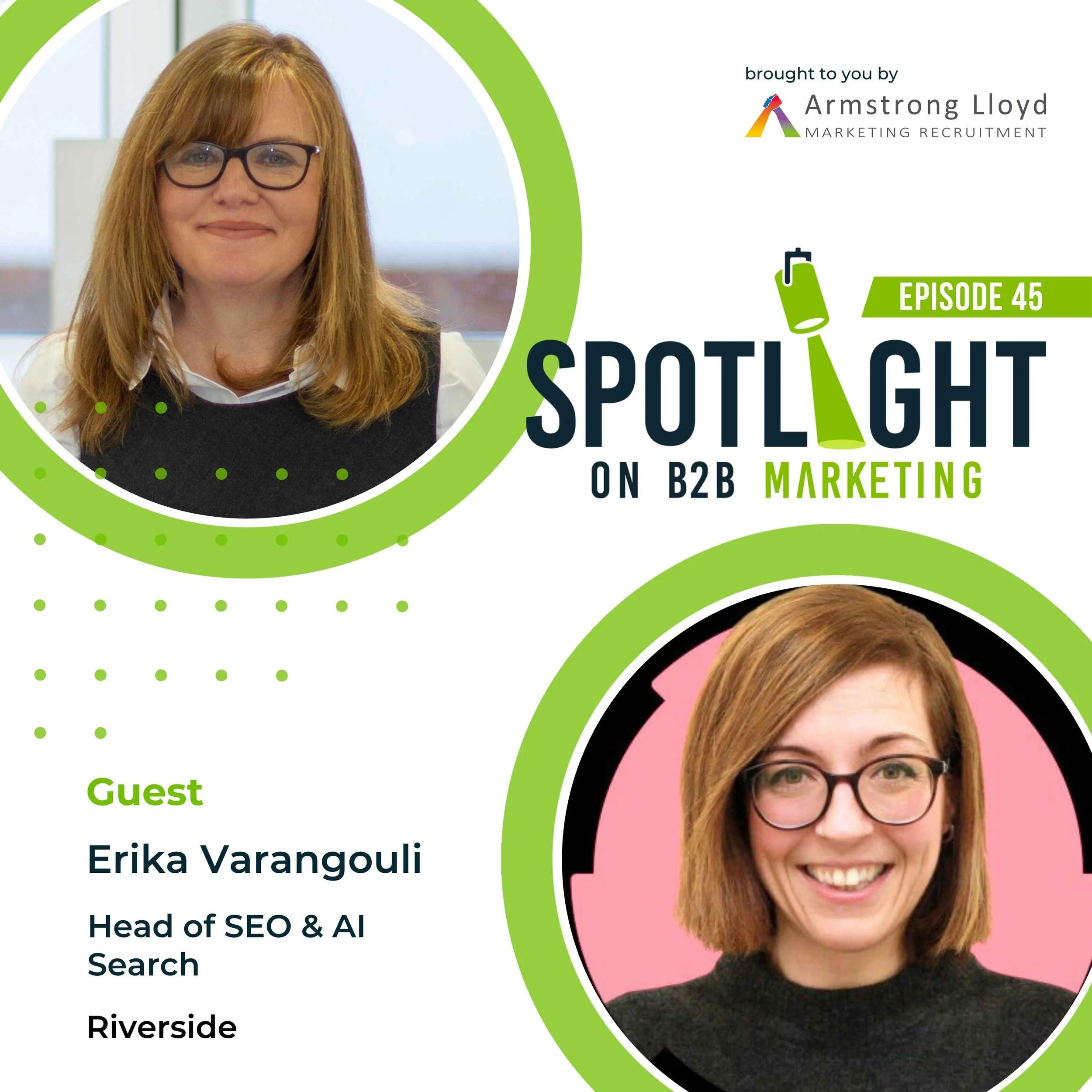
In this episode of Spotlight on B2B Marketing, host Karen Lloyd welcomes Erika Varangouli, Head of SEO and AI Search at Riverside and previously a senior leader at Semrush. With over 13 years of experience driving organic growth, Erika explains why the smartest response to AI search is to step back, diagnose what is really happening and build a brand that AI wants to recommend.
From rethinking KPIs and measuring share of voice to using AI as an analyst rather than a writer, Erika shares practical advice for marketing leaders and smaller teams who want to make every move count.
LISTEN TO
KAREN & ERIKA
What You’ll Learn in This Episode:
✔️ The four areas to investigate before reacting to an organic traffic decline
✔️ Why scaling content with AI is often the wrong first response
✔️ How to rethink KPIs beyond clicks and impressions
✔️ Practical ways to measure share of voice, brand sentiment and AI citations
✔️ Why brand is often owned by no one, and how to fix that
✔️ How to compare the commercial value of brand versus non-brand demand
✔️ Where the line sits between AI-assisted original content and content that will not pay off
EPISODE OUTLINE AND HIGHLIGHTS
[01:27] Where to start when organic traffic is declining and the pressure to use AI is growing
[05:45] Why the brand versus non-brand split now matters more than ever
[06:28] The first wrong reaction: asking your team to write more
[08:14] Rethinking KPIs beyond clicks and impressions
[12:28] How to measure share of voice and why it needs more than one team
[15:40] Helping leadership understand brand, and deciding who owns it
[20:07] Repositioning a brand as your product evolves
[23:30] Why stepping back and auditing is the right move for smaller teams
[26:16] Using AI as a reliable first data analyst
[30:32] AI-assisted content: what is original and what is not
[33:05] Final advice: don’t panic
DIAGNOSE BEFORE YOU ACT
When organic visibility drops, most teams reach for the same lever. As Erika puts it: "That's a very common reflex, right? You see visibility drop and then you ask teams to scale up, especially with AI."
Instead, Erika recommends splitting any decline into four areas. First, measurement: has the way you track performance kept pace with how buyers now find you, or is organic traffic arriving via AI surfaces and being recorded as direct or referral? Second, demand: have searches shrunk, or have the answers simply moved to AI tools? Third, competitors: are they losing ground too, or is it just you? And finally, the losses you chose, such as domain migrations or content pruning.
Only once those are understood should teams look at whether the issue is brand or non-brand, because the response is very different. Her warning is clear:
"unless you diagnose where the drop is coming from, nine out of ten times you'll make the wrong decisions or you'll waste more resource trying to address a problem that isn't there while not tackling the real problem."
For marketing leaders under pressure to act quickly, this is a reminder that the fastest route to results is often a clear diagnosis rather than more activity.
WHY MORE CONTENT IS NOT THE ANSWER
AI has made content production easy for everyone, and that is exactly the problem. "What's really changed is that everyone can do it," Erika explains. When every business is publishing at scale, more content simply adds to the noise, and much of it goes unnoticed by Google and LLMs, or even works against you.
Her advice is to step back and get very clear on where your brand stands, how it is perceived and what your competitors are really doing:
"Because only then you can actually take a very strategic move forward instead of just going, let's produce more content about this. that's an easy choice that won't pay off."
That does not mean avoiding AI. Erika uses it for most of her working day, mainly as a data analyst that can answer a hundred questions in the time an analyst once took to answer one. The test, she says, is what AI helps you achieve:
"If it helps you reach decisions, I think you're using it right. If it helps you ship more, scale faster, do all of that, I think maybe you're at risk of missing something."
Using AI to structure and repurpose original material, such as an interview with your CEO, is a smart use of the technology. What it cannot do is replace your expertise: "AI cannot create the data, the originality in your content."
Key advice for marketing leaders
Diagnose the drop before you react
Split any organic decline into buckets: measurement, demand, competitors and losses you chose, such as migrations or content pruning. Then look at brand versus non-brand. Only then decide where to put resource.
Resist the reflex to produce more content
Asking your team to scale up output with AI is a common first reaction, and often the wrong one. When everyone can produce at scale, more content means more noise and makes it harder to stand out.
Move your KPIs beyond clicks and impressions
Measure share of voice, sentiment and how often your brand is cited in AI answers. Add simple signals such as "how did you hear about us?" and tie organic metrics to business outcomes.
Use AI as your analyst, not your writer
The biggest value of AI is analysing data at speed so you reach better decisions faster. Use it to structure, repurpose and prioritise, but do not hand it the job of writing for you.
Make originality non-negotiable
Original data, expertise and insight from your own people are what AI cannot create. Build skills and guidelines that protect your tone of voice so AI-assisted content still sounds like you.
Key advice for business leaders
Do not judge organic performance on website traffic alone
Buyers may find you through AI answers and then contact you directly. Part of what looks like lost organic traffic may show up elsewhere in your data or be misattributed.
Give your brand a clear owner
Brand is influenced by many teams, including product marketing, social, design and organic, but it is often owned by no one. An owner creates accountability for how brand is built and measured.
Put a commercial value on brand
Compare the cost per acquisition and conversion rates of brand versus non-brand demand across your channels. This turns brand from an abstract idea into a business case.
Break down silos to see the full picture
The real shift is not the technology. It is bringing teams together so SEO, social, product marketing and analysts report on brand and visibility as one view.
Do not panic, and do not assume anything is permanent
AI search is changing constantly. Wins and losses are not fixed, so step back, be strategic and avoid rushing into the playbook that worked before.
TODAY’S GUEST

Erika Varangouli is a B2B marketing leader with over 13 years of experience driving organic growth through SEO, brand authority and AI innovation. She is Head of SEO and AI Search at Riverside, where she leads organic and AI search growth, scaling brand and non-brand visibility across Google, OpenAI and Reddit.
Before Riverside, Erika spent several years at Semrush, where she grew the company’s organic and brand visibility worldwide across four progressively senior leadership roles. Throughout her career, she has worked with brands including Paddle, Capterra, Asics, Symantec, HSBC and Travelex.
Erika is a frequent industry speaker at events such as Spotlight Amsterdam and SERPConf, and has been featured on Google’s “Search Off The Record” podcast. She also contributes to the marketing community as a tutor and awards judge.
Connect with Erika on LinkedIn
OUR HOST

Karen Lloyd is a passionate marketing head-hunter and recruitment expert specialising in marketing and C-suite in B2B industries. With over 25 years of experience in the recruitment industry, Karen brings a unique depth of expertise that sets her apart from most recruiters.
Over her career, Karen has accumulated a wealth of experience that includes serving as a Board Director and being actively involved in growing a business for 13 years. Karen has been a part of five start-ups, giving her first-hand knowledge of the critical importance of hiring the right people.
Currently, Karen is the founder and Director of Armstrong Lloyd. She leads a very special team that partners with businesses and empowers them to build industry-leading marketing and sales teams for some of the most exciting B2B brands - from small, agile and disruptive start-ups to global giants providing a wealth of product and service offerings.
LATEST EPISODES OF THE SPOTLIGHT ON B2B MARKETING