Why AI Products Stall at the Pilot Stage, and It Isn’t the Technology
Most B2B companies building AI products treat slow adoption as evidence that buyers haven’t caught up yet. That diagnosis is usually wrong. Companies stuck at pilot stage are rarely behind on capability. They are behind on translation, and the gap between what a product can do and what a buyer can confidently explain to a budget holder is where deals quietly die.
The instinct when an AI product underperforms is to point at the technology, build more features, add more capability, wait for the market to mature. But buyers don’t adopt technology because it is impressive. They adopt it because it solves something they can already name, and because they can carry that explanation upward to whoever actually approves the spend. A vague pitch fragments on the way up, and trust collapses before the deal closes.
Why AI Deals Stall Before They Reach Production
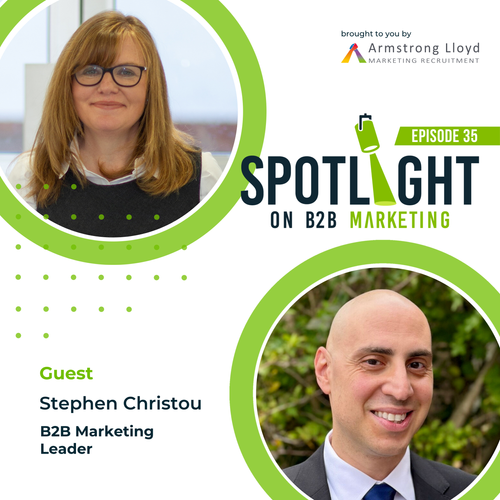
AI products are routinely positioned in broad, transformational language, something that will change how an entire organisation works, rather than around one specific workflow problem a buyer already recognises. On a recent episode of Spotlight on B2B Marketing, guest Stephen Christou, a B2B marketing leader with experience across HPE, TIBCO, and Cohesity, attributed a specific figure to Gartner: around 75% of executives view AI as strategically critical, yet fewer than 25% have moved from pilot to production.
Whatever the precise figure, the underlying mechanism holds up. Buyers carry an explanation upward to whoever approves the spend, and a vague or expansive pitch fragments before it gets there. Stephen put the problem plainly:
“The challenge for companies building AI products today, it’s not about innovation, it’s about translation. The challenge they face is turning complex AI capability into really clear narratives, practical use cases, and really credible proof points so buyers can actually absorb it and adopt it with confidence.”
This points to a discipline worth naming directly: a controlled-disclosure approach to product communication. The strongest AI marketing teams keep building ambitious capability internally without restraint, while being deliberately selective about what they show externally, surfacing only what is real, proven, and usable today, alongside a modest signal of direction. As Stephen described it:
“It’s often wise to control the flow… continue building the ambitious capabilities, but publicly emphasise what works today, give that small signal of where the product’s heading, and keep that balance of credibility and momentum.”
The companies getting this right aren’t innovating fastest. They are making adoption easiest to trust, because every claim a buyer repeats internally is one they can defend later without it falling apart under scrutiny.
AI Has Quietly Rewritten How Buyers Discover Vendors
The same translation failure is playing out in content and SEO, and most B2B marketing teams haven’t caught up. Traditional, keyword-led SEO assumes a buyer is typing search terms into a results page. AI-mediated discovery assumes a system is reading and synthesising an answer on the buyer’s behalf, which rewards clarity and structural authority over keyword density.
Independent research from Meltwater’s analysis of AI chatbot citations across six major models found LinkedIn the second most-cited domain in AI-generated answers, with structured content and clear headings consistently outperforming generic company updates. Separately, Gartner has projected that traditional search volume will decline by a quarter by 2026 as buyers shift toward conversational AI tools.
For most B2B teams, the fix isn’t producing more content. It’s restructuring what already exists so problems, use cases, and comparisons are explained directly enough for an AI system to extract and surface them, then applying that structure consistently rather than chasing volume. Three to five core concepts, approached from different angles and delivered with a steady rhythm, will outperform a high-volume content calendar built on novelty.
Karen Lloyd, founder and Director of Armstrong Lloyd, offered a useful reframe for leaders still wary of the AI label itself:
“The word AI is the mystique and it’s confusing people, but at the end of the day, what it is doing is improving the efficiency in a way a lot of these companies and SaaS products have been able to sort of drive things forward.”
Armstrong Lloyd’s View
We see this translation gap directly in the calibre of marketing leaders coming through our search process. The candidates attracting the most competitive offers from B2B and AI-native companies right now are not the ones with the deepest technical AI knowledge; they are the ones who can demonstrably turn complex capability into a narrative a budget holder will sign off without it falling apart under scrutiny. That skill, translation under commercial pressure, increasingly separates a marketing hire who accelerates pipeline from one who simply produces content.
What Can Business and Marketing Leaders Implement for Their Marketing Teams?
For leaders weighing what this means for their own teams, a few practical starting points stand out:
Audit existing content for clarity before producing more. Restructuring existing material around clear problem statements and use cases is usually faster and cheaper than writing new content from scratch.
Anchor every positioning decision to a tightly defined ICP. When a market changes as quickly as AI does, the ideal customer profile is the only stable reference point for what to build, say, and prioritise next.
Prioritise commercial fluency over technical depth when scaling a team. Whether hiring a first content lead or expanding into new regions, the skill in highest demand is converting complexity into something a buyer can act on with confidence.
Treat AI SEO as a structural project, not a content sprint. Restructuring for clarity and authority tends to outperform volume-led approaches, and is a smaller lift than most teams assume.
About Karen Lloyd

As the founder and director behind our recruitment approach, I bring almost 30 years of unique expertise spanning both recruitment and marketing. Having placed my first candidate in 1996, I've since built 5 start-ups, served as a Board Director for 25 years and developed recruitment strategies that work in competitive talent markets.
I'm also the host of "Spotlight on B2B Marketing", where I explore B2B marketing trends with industry leaders. My passion lies in helping global businesses grow their revenue-generating teams through strategic hiring and fractional CMO services.
About Armstrong Lloyd
Armstrong Lloyd goes above and beyond being a pure search firm - we partner with your business because we have all stood in your shoes as experienced hiring managers, marketing and operational business leaders. We have a hidden network that goes beyond LinkedIn searches, adverts, or referrals from ex-colleagues to ensure you're getting the top 1% of talent.
Whether you need interim leadership, marketing team building, or executive search across the UK and beyond, the team at Armstrong Lloyd are here to ensure you reach your commercial business goals by building the best marketing team and strategy to give you a competitive advantage.
Ready to transform your marketing team? Let's talk about how we can help you hire the right talent at the right time.
MORE B2B MARKETING RECRUITMENT INSIGHTS