Why Standing Still Is No Longer a Strategy for B2B Leaders
The pace of change inside business has never moved faster, and the instinct to wait for a clearer picture before acting has never been more costly. AI is reshaping how organisations operate, and macroeconomic pressure means there is less room than ever to do nothing while waiting for certainty. Businesses that delay experimentation are not protecting themselves. They are storing up a problem that surfaces later, often once it is harder to fix.
Building While Flying: Why Waiting for Certainty Is the Real Risk
Most established organisations approach major change cautiously. Processes are embedded, mindsets are set, and the instinct is to wait until the path is clear before committing. Yet this caution often creates the very risk it is trying to avoid, because the businesses that hesitate longest are the ones that feel the gap widen against competitors who started experimenting sooner.
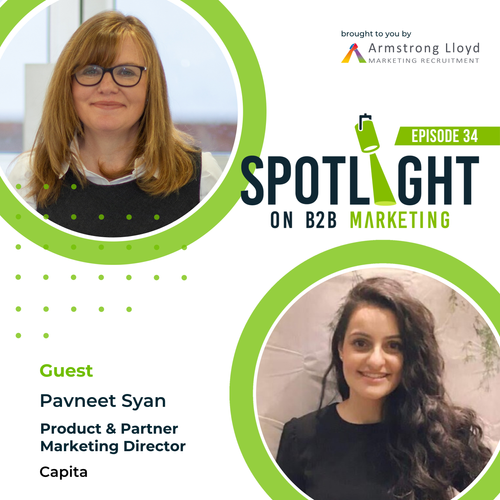
Pavneet Syan, Marketing Director at Capita's AI organisation, recently joined the Spotlight on B2B Marketing podcast to talk about leading transformation inside a large, established business. Her view is direct: organisations that aren't experimenting now will feel it later, typically within six to eighteen months, once the gap in capability becomes visible. As she put it on the episode, "if you don't swim, you'll end up sinking."
That urgency isn't only about AI. It's AI and macroeconomic pressure compounding each other, both pushing organisations to move faster with fewer resources at the same time. Pavneet describes the resulting pace of change as "building while we're flying," a fitting description of what it actually feels like to lead transformation when nobody, including senior leadership, has all the answers yet. As she said plainly, she doesn't believe "any one person is the true expert right now."
People Before Process: The Real Work of Leading Change
Pace alone doesn't make transformation stick. What does is understanding the people inside the organisation, their motivations, their anxieties, and where they see their own place in the bigger picture. This isn't preparation for the real work of change leadership. It is the real work.
Getting everyone pulling in the same direction only happens once people understand the shared goal and their part in it. That takes more than top-down communication. It means in-person time, hands-on workshops, and genuine human connection.
It also means accepting that not everyone will come along. Where resistance is persistent despite real effort, continuing to spend energy trying to change minds can hold the rest of the organisation back. The balance is finding the sweet spot between pace and durability: change of this kind is not a sprint, it's a marathon, even while the pace itself needs to stay fast.
Karen Lloyd, founder of Armstrong Lloyd, has seen this play out across 25 years of placing leaders into exactly these environments. As she's said before, "some people, they don't join companies, they join the leadership." The calibre of the person leading a team through change often matters more than the transformation plan itself.
Knowledge That Doesn't Walk Out the Door
A practical thread worth pulling out is how organisations retain what they learn during a transformation, rather than losing it whenever someone moves on. The strongest approach is to establish a clear source of truth early, then use the tools already available to let teams build on that baseline rather than starting again each time someone leaves.
This matters more than it might seem. The structures meant to pass on institutional knowledge between people are often already stretched thin, even before a major transformation adds further pressure. Getting this right early avoids the slow, quiet loss of expertise that only becomes obvious once it's too late to fix easily.
Our View
We see this pattern repeatedly when working with B2B businesses going through AI-led transformation. The technology decisions get the executive airtime, but the people decisions determine whether the transformation actually lands. The marketing leaders in highest demand right now are the ones comfortable operating without a finished playbook, while also being deliberate about bringing a team through change rather than simply directing it from the top. That combination is harder to find than either skill on its own, which is exactly why it commands a premium in the current market.
What Can Business and Marketing Leaders Implement for Their Marketing Teams?
Treat experimentation as a standing budget line, not a one-off project. Set aside a fixed proportion of marketing resource each quarter purely for testing new AI tools or workflows, reviewed on a regular cycle, so that experimentation doesn't quietly stop once the initial pressure to act has passed.
Build a single source of truth before you need it. Capture process knowledge, customer insight, and tooling decisions in one accessible place as you go, rather than after someone resigns. This becomes critical when scaling a team quickly or expanding into new markets, where new hires need to get up to speed without relying on one or two long-tenured people.
Hire for comfort with ambiguity, not just technical AI skills. When recruiting for transformation-facing roles, test for how candidates have led teams through unresolved, in-progress change in the past, not just whether they can list the tools they've used.
Accept that some resistance is a resourcing decision, not a communication failure. Where a team member remains resistant despite genuine investment, recognise that continuing to redirect leadership energy there has a real cost against the colleagues who are ready to move, particularly in lean teams scaling at pace.
About Karen Lloyd

As the founder and director behind our recruitment approach, I bring almost 30 years of unique expertise spanning both recruitment and marketing. Having placed my first candidate in 1996, I've since built 5 start-ups, served as a Board Director for 25 years and developed recruitment strategies that work in competitive talent markets.
I'm also the host of "Spotlight on B2B Marketing", where I explore B2B marketing trends with industry leaders. My passion lies in helping global businesses grow their revenue-generating teams through strategic hiring and fractional CMO services.
About Armstrong Lloyd
Armstrong Lloyd goes above and beyond being a pure search firm - we partner with your business because we have all stood in your shoes as experienced hiring managers, marketing and operational business leaders. We have a hidden network that goes beyond LinkedIn searches, adverts, or referrals from ex-colleagues to ensure you're getting the top 1% of talent.
Whether you need interim leadership, marketing team building, or executive search across the UK and beyond, the team at Armstrong Lloyd are here to ensure you reach your commercial business goals by building the best marketing team and strategy to give you a competitive advantage.
Ready to transform your marketing team? Let's talk about how we can help you hire the right talent at the right time.
MORE B2B MARKETING RECRUITMENT INSIGHTS