Sales and Marketing Alignment: Why It's Rarely a People Problem
Sales and marketing misalignment is rarely solved by better training or better leads. It is usually structural, buried in places leaders don't think to look, such as the wording of a contract or the assumption that a strong logo list travels across borders unchanged. Treating it as a personality clash misses where the fix usually lives: in getting both functions to own the problem, and the solution, together.
The logo problem is rarely about the logos
A common assumption in B2B go-to-market strategy is that proof of customer success travels freely across markets: if a business has an impressive roster of logos in one region, that credibility should transfer wherever it expands next. In practice, it rarely does; buyers want evidence that companies like theirs, in their own market, have already bought and succeeded.
What turns this into a structural problem rather than a messaging one is that the barrier is often buried in commercial paperwork rather than the marketing plan. Contract or master agreement clauses covering customer references and case study rights are frequently written in dense, cautious legal language, and sales teams, keen to close deals quickly, will often negotiate them away during procurement rather than push back. Repeated across enough deals, the result is a business that can win customers in a new market but can never point back to them, starving the next deal of exactly the proof it needs.
Armstrong Lloyd sees this pattern regularly when supporting B2B businesses expanding into new markets: the barrier to growth is rarely a lack of marketing effort, it is a legal default nobody has revisited since the business was smaller. Recruiting the right marketing leader matters, but the mandate to challenge the paperwork only works if sales is at the table too, since sales is usually the function negotiating the clause away in the first place.
Why blame is the real derailment risk
A shared mandate is one thing; a shared response to bad news is another, and it's usually the second that determines whether sales and marketing function as one team. When a pipeline underperforms, there are two familiar ways for it to go wrong: marketing blames sales for not closing the leads it generates, or sales blames marketing for supplying the wrong ones. Both stop the organisation asking the more useful question, whether the target market itself has been correctly defined and resourced.
The more productive default is to treat underperformance as a signal to investigate together rather than a fault to assign, bringing sales, marketing and customer success into the same room early as joint owners of the outcome, with two working rules: no blaming each other, and no waiting passively to be handed an answer. Organisations that build this instinct reach the real cause, whether that's a contractual barrier, a mismatched market, or a genuine execution gap, far faster than those that default to departmental blame.
A useful diagnostic: ask why before asking how much
Getting sales and marketing to investigate together only helps if they're asking the right question. Many reviews default to a volume question: are we generating enough leads, are we hitting our meeting targets. That question can be answered affirmatively while the underlying problem, the market, the offer or the proof points, remains unaddressed. A more useful discipline is to treat conversion rates as a prompt for both functions to ask why together before reaching for how much, since a volume fix applied to a fit problem simply produces more of the same unconverted leads.
This distinction matters because the data backs it up. Research from Aberdeen Group found that highly aligned sales and marketing organisations achieve 32% year-over-year revenue growth, against a 7% decline for less aligned competitors, a pattern reflected in analysis by The Growth Syndicate. That gap is difficult to close through lead scoring alone; it needs the habits described above.
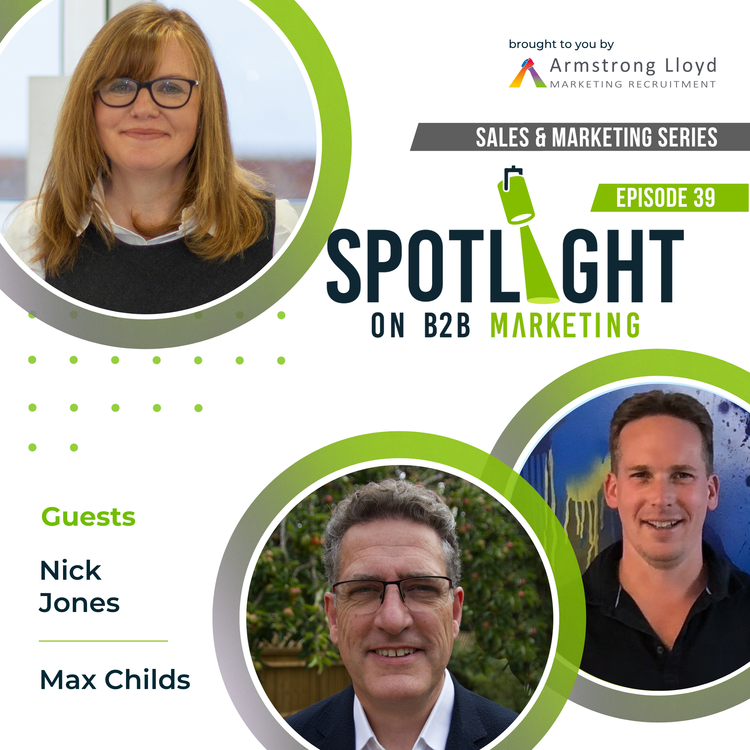
This thinking played out on a recent episode of Spotlight on B2B Marketing (published 22 July 2026), where host Karen Lloyd, founder of Armstrong Lloyd, spoke with Nick Jones and Max Childs about an EMEA pipeline that grew from close to zero to a record year. Nick Jones is the founder of Glendower Advisory and formerly Managing Director for EMEA and APAC at Lucidworks; Max Childs is a Fractional Marketing Director at Technology Marketing Europe, previously EMEA and APAC marketing lead at Lucidworks. Max summed up the instinct that broke their deadlock plainly: "the really, really important thing is always the why." Karen's reflection on how rarely organisations reach that stage was equally direct: "it isn't normal in every company." Listen to the full episode here.
What can business and marketing leaders implement to get sales and marketing working as one team?

Audit commercial paperwork with sales in the room. Contract clauses, SLAs and procurement templates can quietly block the case studies marketing needs most, and sales usually knows where those clauses get negotiated away. Review them together, with legal.
Set explicit ground rules before conflict appears. Two simple principles, no blaming each other and no waiting to be handed the answer, reset how sales and marketing behave under pressure long before a crisis forces the conversation.
Make stalled conversion a joint "why" exercise, not a volume exercise. When leads stop converting, bring both functions together to investigate whether the market fit, offer or proof points are wrong before assuming either team needs more leads or training.
Give both leaders genuine cross-functional reach. A marketing leader who can only influence campaigns, not contracts or sales process, will keep hitting the same barriers. Recruit and mandate both sides for the broader remit, not just their own function.
If you're building or restructuring a team to get sales and marketing working as one, Armstrong Lloyd can help you find the leadership to make it work.
About Karen Lloyd

As the founder and director behind our recruitment approach, I bring almost 30 years of unique expertise spanning both recruitment and marketing. Having placed my first candidate in 1996, I've since built 5 start-ups, served as a Board Director for 25 years and developed recruitment strategies that work in competitive talent markets.
I'm also the host of "Spotlight on B2B Marketing", where I explore B2B marketing trends with industry leaders. My passion lies in helping global businesses grow their revenue-generating teams through strategic hiring and fractional CMO services.
About Armstrong Lloyd
Armstrong Lloyd goes above and beyond being a pure search firm - we partner with your business because we have all stood in your shoes as experienced hiring managers, marketing and operational business leaders. We have a hidden network that goes beyond LinkedIn searches, adverts, or referrals from ex-colleagues to ensure you're getting the top 1% of talent.
Whether you need interim leadership, marketing team building, or executive search across the UK and beyond, the team at Armstrong Lloyd are here to ensure you reach your commercial business goals by building the best marketing team and strategy to give you a competitive advantage.
Ready to transform your marketing team? Let's talk about how we can help you hire the right talent at the right time.
MORE B2B MARKETING RECRUITMENT INSIGHTS