

Armstrong Lloyd is a specialist B2B marketing recruitment agency based in the UK. Established in 2014 by Karen Lloyd, we work with established and scaling B2B businesses to hire marketing leaders and team members across demand generation, product marketing, marketing operations and brand. Unlike generalist recruiters, we focus exclusively on B2B marketing and sales, giving us a deeper understanding of the roles, the talent market and what strong performance looks like at each level.
WHAT DOES A B2B MARKETING RECRUITER DO?

A B2B marketing recruiter focuses on identifying and assessing marketing talent for organisations that operate in complex, multi‑stakeholder environments. The key distinction between a specialist and a generalist agency is depth of market knowledge. Rather than relying on CV matching, a specialist understands B2B marketing disciplines and has a clearer view of what strong performance looks like.
The role is both sourcing and advisory. Recruiters evaluate candidates, but they also work with hiring managers to shape realistic briefs, set expectations around salary levels and provide insight into candidate availability, ensuring the hiring process aligns with market conditions.
Effective B2B recruitment relies on niche understanding. Long sales cycles, account based strategies, revenue contribution and technical product knowledge all influence the type of marketer a business needs. Without this context, it is difficult to assess candidates accurately.
Armstrong Lloyd operates as a recruitment partner rather than a supplier, working closely with marketing leaders, founders and senior executives to define requirements, shape teams and secure talent that aligns with business strategy.
WHICH B2B MARKETING ROLES DO COMPANIES HIRE?
B2B marketing hiring typically spans four broad functions: senior leadership, brand and communications, demand and operations and digital marketing. The full breakdown of roles sits on our dedicated roles page, which gives a complete view of the titles we cover. This section highlights the uniquely B2B roles where specialist expertise matters most and where the right hire depends on growth stage and smart team sequencing.
WHAT DO B2B MARKETING ROLES PAY IN THE UK?
| Level | Role Examples | UK Salary Range |
|---|---|---|
| Executive | CMO / VP Marketing | £130,000 – £300,000 |
| Senior | Head of Marketing / Marketing Director | £70,000 – £150,000 |
| Mid | Marketing Manager (B2B) | £41,757 – £80,000 |
| Mid – Specialist | Demand Gen Manager | £44,000 – £90,000 |
| Mid – Specialist | Product Marketing Manager | £51,000 – £90,000 |
| Mid – Specialist | Marketing Ops Manager | £45,000 – £75,000 |
| Junior | Marketing Executive | £25,773 – £40,592 |
Salary expectations in B2B marketing vary widely depending on seniority, industry and where the role is based. Across UK B2B sectors, salaries vary by industry and growth stage. In technology and high-growth environments, a mid-level marketing manager can earn around £60k, while more traditional sectors often benchmark lower for similar responsibilities. London and major UK hubs typically command an uplift of 8–15% due to competition and cost of talent. The range showcased provides a reliable snapshot of current UK market norms.
They reflect the roles we recruit for most frequently and the salary patterns we see across retained, exclusive and contingency searches. Specialist functions such as demand generation, product marketing and marketing operations continue to attract a premium due to their direct impact on pipeline and revenue.
These salary ranges are based on live recruitment data gathered by Armstrong Lloyd in 2025, across retained, exclusive and contingency searches in the UK B2B marketing sector. They are updated regularly to reflect current market conditions.
These figures should be treated as a guide rather than a fixed rule.
Final compensation is influenced by organisational structure, growth stage, reporting lines and the strategic weight placed on marketing within the business. For a deeper breakdown by sector, location and seniority, the Armstrong Lloyd Salary & Diversity Report offers a more detailed view.
HOW IS B2B MARKETING HIRING DIFFERENT FROM B2C?
A common misconception is that strong B2C experience automatically translates into B2B. In reality, the two different environments often require capabilities, identify synergies and recognising this helps hiring managers make better decisions and avoid costly mis‑hires.
B2B marketers need to demonstrate commercial acumen, with a clear link between their work and pipeline creation, revenue contribution and sales performance, rather than focusing solely on brand metrics or impressions. They also need strong technical literacy, as CRM platforms, marketing automation tools and attribution models are considered essential skills rather than optional extras.
Hiring B2C talent into a B2B role requires careful identification of role synergies. Someone may have impressive consumer brand credentials but lack understanding of enterprise buying committees, long sales cycles and account based marketing. This is why the assessment approach in B2B is different. Candidates are evaluated on go to market thinking, commercial strategy and alignment with sales.
B2B MARKETING RECRUITMENT: CLIENT CASE STUDIES


SECTOR: FINTECH & PAYMENTS
Blackhawk Network needed to build a multi‑disciplinary B2B marketing team to support a refreshed strategy across their global payments business. Their Senior Marketing Director required the right blend of talent to drive demand, develop plans and improve marketing ROI.
Armstrong Lloyd partnered closely with him to shape the brief, map the market and deliver a team of five high‑impact marketers who have significantly advanced business goals.
“From the get‑go, Armstrong Lloyd invested time to deeply understand the business and what I was wanting to achieve.” - Ed Ward, Senior Marketing Director
SECTOR: CYBER-SECURITY
IriusRisk was scaling rapidly after Series-A funding and needed a marketing leader who could unify brand, product and demand generation while supporting global expansion. Initial interviews revealed the need for a broader strategic VP rather than a pure demand‑gen specialist.
Armstrong Lloyd delivered a shortlist of high‑calibre candidates, leading to the appointment of a VP who has since driven significant commercial impact.
“Supported by Armstrong Lloyd, the new VP of Marketing has lost no time in starting the process to build the strongest marketing team IriusRisk have ever had.”
HOW DO YOU SCALE B2B MARKETING TEAMS?

Scaling a B2B marketing team works best when hiring follows strategy rather than convention. The starting point is always the revenue goal. Before deciding who to hire, a business needs clarity on what marketing must deliver commercially, how it supports sales and what success looks like in measurable terms.
A common sequencing mistake is hiring a large team before the foundations are in place. Without a clearly defined customer, messaging framework and tech stack, even strong marketers will struggle to make an impact. This is explored in episode 30 of our Spotlight on B2B Marketing podcast, which focuses on the importance of getting the fundamentals right before scaling.
Interim and contract hires can be valuable when a company needs momentum while building a permanent team. They are particularly useful for PE-backed or fast-growth organisations that need immediate capability, specialist expertise or short-term leadership. We cover this in episode 23, which looks at when fractional or interim support is the right choice.
Strong candidates are put off by unclear or unrealistic job descriptions. Vague remits, broad scopes and no defined success metrics make it difficult for senior marketers to understand what they are being hired to achieve. Clear outcomes, realistic expectations and alignment with sales are essential. Our guidance on this is expanded in episode 31, which focuses on sales, marketing and product alignment.
FREQUENTLY ASKED QUESTIONS ABOUT B2B MARKETING RECRUITMENT
-
Companies typically hire their first senior B2B marketing leader when revenue growth depends on a repeatable demand engine rather than founder-led sales. At this stage, a Head of Marketing or Marketing Director can define the go-to-market strategy, messaging, and demand generation model. We explore this in more depth in Episode 32 of our Spotlight on B2B Tech Marketing podcast.
-
Early-stage businesses usually need a generalist marketing leader who can build the foundation. Growth-stage companies often require specialists in demand generation, product marketing, and marketing operations to scale pipeline and revenue.
-
Strong B2B marketers are measured on pipeline contribution, revenue influence, and sales alignment. Their success is typically tied to demand generation performance, conversion rates, and marketing’s share of new business revenue.
-
B2B marketing talent is scarce because the role requires a combination of commercial thinking, technical marketing skills, and sector knowledge. Experienced marketers who understand long sales cycles, CRM systems, and enterprise buying processes are in high demand.
-
Most companies start with a strategic generalist leader, then add specialists such as demand generation, product marketing, and marketing operations once the foundations ICP, messaging, and tech stack are established.
-
Armstrong Lloyd focuses exclusively on B2B marketing and sales recruitment. Unlike generalist agencies, we do not recruit across all functions or sectors. This means our market knowledge is deeper, our candidate networks are more relevant, and our ability to assess marketing talent in a B2B context is more accurate. We work as a recruitment partner rather than a transactional supplier, which means we are involved in shaping the brief, not just filling it.
-
Senior marketing leaders such as Heads of Marketing or Marketing Directors typically earn £70k–£125k, while CMOs or VP Marketing roles can range from £130k–£300k depending on company size and sector.
-
Common mistakes include:
Writing vague job descriptions
Expecting one hire to cover every marketing discipline
Hiring too many people before defining the strategy
Clear success metrics and scope are essential to attract strong candidates.
-
Many companies use interim or contract marketing leaders when scaling quickly or preparing for investment. This approach allows businesses to build strategy and infrastructure before committing to permanent hires.
-
Sometimes but not always. B2B marketing requires understanding complex buying committees, long sales cycles, and revenue attribution, which are rarely core parts of most B2C marketing roles.
-
For leadership roles, the process typically takes 6–12 weeks. This includes defining the role, identifying candidates with the right sector experience, and aligning stakeholders on what success looks like.
-
Armstrong Lloyd recruits B2B marketing roles across all B2B sectors.
We have a specialist focus on manufacturing, professional services, engineering, financial services, construction, membership bodies, business consultancy and software and technology. In software we have specific expertise in SaaS, fintech, cybersecurity, payments, legaltech, AI and digital transformation.
Our focus is on businesses operating in complex, multi-stakeholder environments where marketing is directly tied to pipeline and revenue growth.
B2B MARKETING RECRUITMENT INSIGHTS & ADVICE


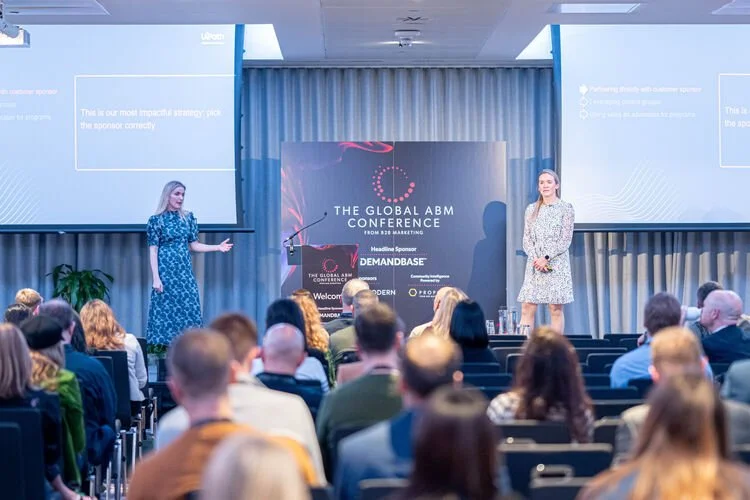
This page was written by Karen Lloyd, Director and founder of Armstrong Lloyd and host of the Spotlight on B2B Marketing podcast. Karen brings nearly 30 years of experience across recruitment leadership, commercial strategy and B2B talent acquisition. She has worked with marketing leaders, founders and HR Directors across technology, SaaS, fintech and cybersecurity businesses, helping them build high-performing marketing and sales teams. Learn more about Karen Lloyd.
Why B2B market entry fails when it's treated as a single campaign, and what sustained presence actually takes to build trust in a new region.